In 2026, the gap between a “growing business” and a “market leader” is defined by one thing: the customer experience. If you are still managing customer inquiries through a cluttered Gmail inbox or a shared spreadsheet, you aren’t just losing time—you’re losing revenue. Investing in help desk software for small business is no longer a luxury; it is a fundamental requirement for scaling operations in the competitive US market.
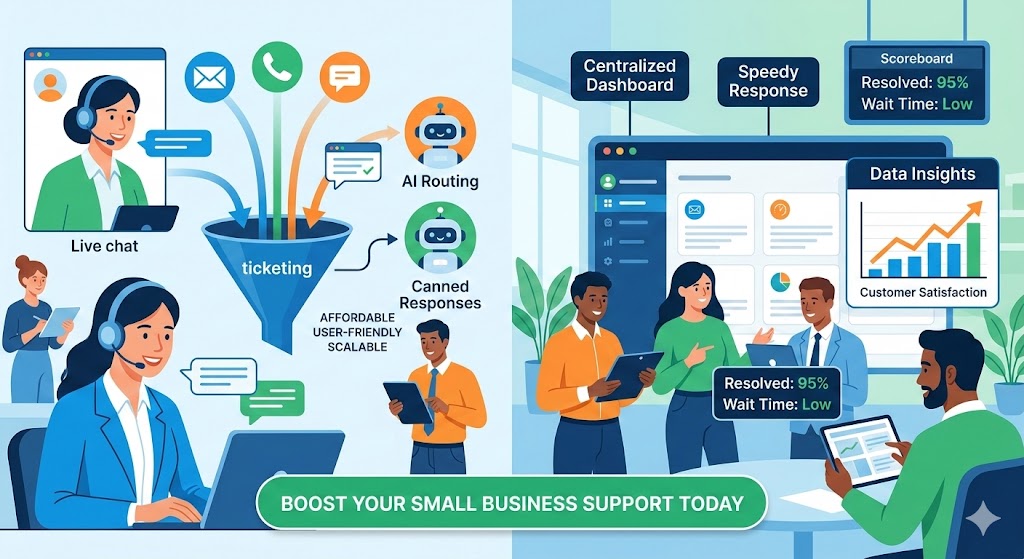
Modern help desk solutions do more than just organize emails. They centralize communication, automate repetitive tasks, and provide the data-driven insights you need to keep your customers happy.
The Core Benefits of a Small Business Ticketing System
When you implement the right help desk software for small business, you unlock several transformative benefits:
- Centralized Communication: Whether a customer reaches out via email, live chat, or social media, every inquiry is converted into a single ticket. No more “losing” an email in a sub-folder.
- AI-Powered Efficiency: By 2026, AI has become the backbone of support. Even basic plans now offer AI-driven ticket routing and automated “canned responses” that handle FAQs without human intervention.
- Accountability and Tracking: With a dedicated system, you can see exactly who is working on what, how long it takes to resolve an issue, and which customers are waiting for a reply.
Top 5 Help Desk Software for Small Business Options in 2026
Choosing the right tool depends on your specific workflow. Here is a breakdown of the top contenders currently dominating the US small business landscape.
1. Zoho Desk: The Best Value for Cost-Conscious Teams
Zoho Desk remains a favorite for American entrepreneurs because of its incredible “bang for your buck.” It integrates seamlessly with the broader Zoho ecosystem (CRM, Books, etc.).
- Key Feature: Zia, an AI assistant that tags tickets and sentiment.
- Pricing: Starts at approximately $7/user/month.
2. Freshdesk: The Easiest to Set Up
If you need to get up and running in under an hour, Freshdesk is the gold standard. It offers an intuitive interface that requires almost zero training for your agents.
- Key Feature: Freddy AI for automated ticket categorization.
- Pricing: Offers a robust free tier; paid plans start around $15/user/month.
3. Help Scout: The “Human-First” Choice
Many small businesses hate the “robotic” feel of ticket numbers. Help Scout is designed to look like a personal email to the customer while providing powerful behind-the-scenes collaboration tools for your team.
- Key Feature: Shared inboxes that prevent “collision” (two agents replying to the same person).
- Pricing: Starts at $25/user/month.
4. Tidio: Best for Real-Time Sales & Support
Tidio blends live chat with traditional ticketing. It’s perfect for small e-commerce businesses that want to engage visitors on their site and turn them into customers while providing support.
- Key Feature: Lyro AI, a conversational bot that resolves up to 70% of common questions.
- Pricing: Free plan available; paid tiers start at $29/month.
5. HubSpot Service Hub: The Best for Scaling
If your small business is growing rapidly, HubSpot offers a platform that grows with you. While the entry-level tools are free, the professional features integrate deeply with your marketing and sales data.
- Key Feature: Unified customer view across the entire journey.
- Pricing: Free tools available; starter sets around $15/month.
What to Look for When Comparing Help Desk Solutions
Not all help desk software for small business is created equal. To ensure you’re making a smart investment, prioritize these three factors:
Multichannel Capabilities
Your customers are everywhere. Your software must be able to pull in queries from Email, WhatsApp, Instagram, and Live Chat. A “siloed” system will only create more work for your team.
Automation and AI
In 2026, you shouldn’t be manually assigning tickets. Look for “agentic” capabilities—tools that can understand the intent of a message and either solve it automatically or route it to the specific person best equipped to handle it.
Ease of Integration
Your help desk shouldn’t be an island. It needs to “talk” to the tools you already use, such as Slack, Shopify, or your CRM.
Conclusion: Take the Leap Toward Better Support
Choosing the right help desk software for small business is about more than just managing “complaints.” It’s about building a foundation of trust with your audience. By automating the mundane, you free up your team to focus on what truly matters: providing a personalized, human touch that keeps customers coming back.